
shutterstock-153230282-neodymium-magnets

APPLICATIONS OF THERMO-CALC

Permanent Magnets

Thermo-Calc can be used to predict the thermodynamics and phase equilibria of a wide range of rare earth permanent magnet compositions from pure Nd2Fe14B to very complex NdFeB-based and SmCo-based alloys used for the production of commercial permanent magnets. 

Applications for Permanent Magnetic Materials

Anisotropic bulk permanent magnets based on Nd-Fe-B alloys are the most widely used types of rare earth magnets, and their fabrication requires precise control of their microstructure. Two approaches to producing such magnets are (i) powder metallurgical sintering and (ii) rapid solidification followed by hot-deformation. In both cases, the resultant phase constitutions and morphology of the microstructure depend on the chemical compositions of the magnets and the processing conditions. Improved knowledge of the underlying thermodynamics and phase equilibria of these systems are important to improving the processing reliability and further development of Nd-Fe-B-based magnets.

Additionally, commercial Nd-Fe-B magnets are not just a simple ternary system, but rather exist as multicomponent alloys where additional elements such La, Ce, and Pr can be adopted to substitute for the more expensive Nd. Other elements may also be added to improve properties such as coercivity.

SmCo permanent magnets are known for their excellent performance in extreme environments, with high magnetic strength (second only to NdFeB magnets) and high coercivity. They are primarily made from Sm and Co, with small additions of Fe, Cu, or Zr depending on the grade.

There is limited handbook data available for these multicomponent alloys, and those that exist do not always take into account variations in chemistry or processing conditions. Where this data is missing, Thermo-Calc can be used to generate the materials property data and make predictions of material behavior throughout the materials life cycle.

Calculate the following, based on your actual alloy chemistry:

  • Thermophysical properties, such as:
    • Specific heat, enthalpy, and latent heat (for all phases), and the molar volume, viscosity, and surface tension of liquid only, electrical resistivity, and thermal conductivity
    • Phase-based properties, such as:
      • Critical transformation temperatures such as solvus temperatures of precipitates, amounts and compositions of phases, solubility limits, activities, phase diagrams, and more
      • Equilibrium and non-equilibrium solidification, such as:
        • Liquidus, solidus, incipient melt temperatures, freezing range, fraction solid curves, solidification path, fraction eutectic, microsegregation, partition coefficients, latent heat, shrinkage, and more
        • Curie temperature

Application Examples

Thermo-Calc has many applications to NdFeB- and SmCo-based  Permanent Magnets. Below are two such examples.

Prediction of Curie Temperatures

The Curie temperature (Tc) is a critical temperature, above which certain materials lose their permanent magnetic properties. It is therefore one of the most important properties for permanent magnetic materials. As a result, developing new alloys that extend the temperature range of practical usage along with good structural stability is of strong interest.

The Curie temperature can be predicted using Thermo-Calc as a function of chemical composition. A comparison is made in the plot here against collected experimental data for a number of given permanent magnetic alloys.
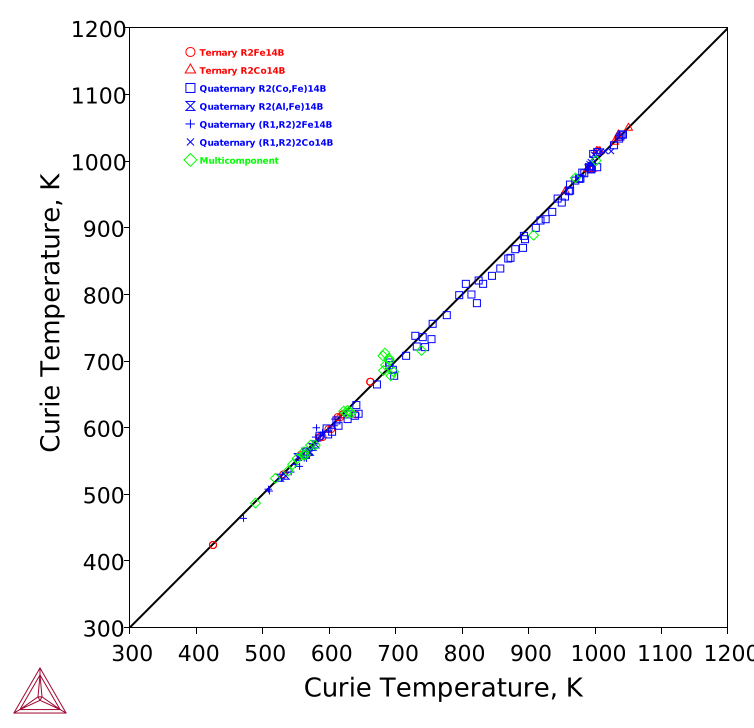
A plot showing the comparison of calculated vs experimental Curie temperatures for several permanent magnetic alloys.

Prediction of Thermophysical Properties for Permanent Magnets

Several of the permanent magnets (such as Nd-Fe-B permanent magnets) are processed via powder metallurgy. To ensure a fully dense and defect free material, it is useful to have a good wetting behaviour of the Nd-rich liquid phase, which can be directly studied using surface tension of the melt.

Many thermophysical properties are included in the Permanent Magnet Database, which means viscosity, surface tension, electrical resistivity, and thermal conductivity can be calculated as a function of composition and temperature in Thermo-Calc. The plot here is a validation example comparing experimental and simulated surface tension for an Nd-Fe-B-Ga alloy from Noguchi et al., 2021. Ga is added as a quaternary element to the Nd-Fe-B alloy for increasing coercivity and improving wettability of the resulting material.
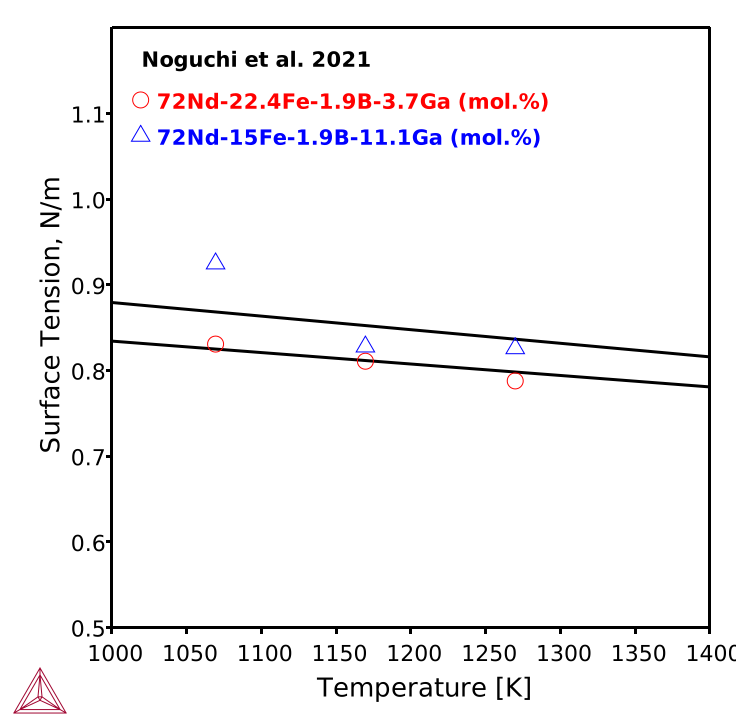
A plot showing the comparison of experimental and simulated surface tension for an Nd-Fe-B-Ga permanent magnetic alloy.

Learn more about Applications to Permanent Magnetic Materials

Multiscale understanding of microstructural evolution during directional solidification of magnetostrictive Tb-Dy-Fe alloys

A collection of examples that demonstrate the validity and calculation abilities of the TCPMAG database.


Let Us Help You

Is Thermo-Calc Right for You?

Talk to one of our experts to learn whether our tools or services fit your needs.